
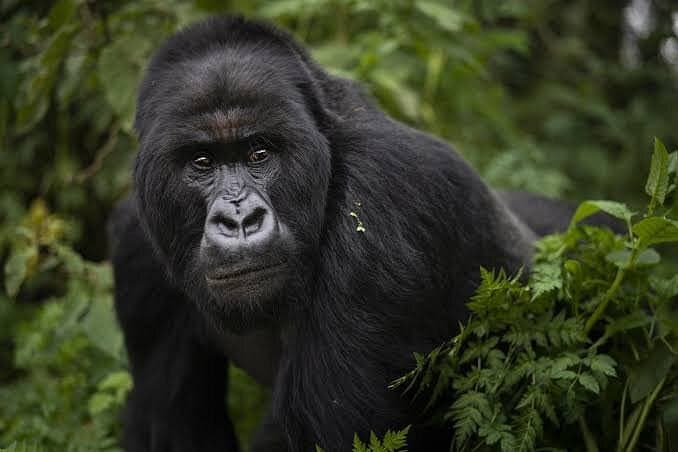

Uganda and Rwanda are the two main gorilla trekking destinations in the world, sharing a common population of mountain gorillas in the Virunga ecosystem and the Bwindi forest. The experience of trekking is broadly similar — a morning hike to find a habituated family, followed by one strictly protected hour at close range. What is different is everything around it: cost, permit availability, terrain, lodge standards, and the wider trip context.
The gorillas themselves
Uganda holds more habituated gorilla families than any other country — over 20 in Bwindi Impenetrable Forest alone, across four separate trekking sectors, plus one additional family in Mgahinga. Rwanda's Volcanoes National Park has 12 habituated families. More families in Uganda means better permit availability, more flexibility in trek dates, and a greater spread of difficulty levels across different sectors.
The gorillas in both countries belong to the same Virunga mountain gorilla population and behave identically in both. The one-hour encounter is the same. The animals are the same species. The setting is what differs.
Cost
This is the most significant practical difference. Uganda gorilla permits cost $800 per person. Rwanda permits cost $1,500. On a trip for two people, that is $1,400 versus $3,000 in permit costs alone — a difference that compounds when you factor in lodge rates, which also tend to run higher in Rwanda's more premium market.
Terrain and difficulty
Bwindi in Uganda is dense, ancient rainforest — humid, sometimes steep, sometimes muddy. Treks range from 1 to 8 hours depending on the family's location. The southern Rushaga and Nkuringo sectors tend to involve more demanding terrain; the northern Buhoma sector is generally considered easier. Rwanda's Volcanoes National Park involves trekking on volcanic slopes at altitude (2,400–3,000m), which can be demanding for less fit travellers. Both parks provide porters, and we strongly recommend hiring one.
Lodge standards
Rwanda has the finest gorilla trekking accommodation on the continent. Properties like Bisate Lodge and Singita Kwitonda operate at a level that has no direct equivalent in Uganda. Uganda's luxury lodges — Buhoma Lodge, Clouds Mountain Gorilla Lodge — are excellent, but Rwanda's benchmark is higher. If the quality of accommodation matters as much as the trekking itself, Rwanda is the answer.
The wider trip
Uganda offers more to combine around the gorillas: Queen Elizabeth National Park (tree-climbing lions, boat safaris), Murchison Falls (one of Africa's most dramatic landscapes), Kibale Forest (the best chimpanzee trekking in Africa), and the Rwenzori mountains. Rwanda's wider circuit is smaller but coherent: Nyungwe Forest for chimps, Akagera for the Big Five. Both countries connect easily to Kenya and Tanzania for a multi-country circuit.
If cost and wildlife depth are the priority, Uganda wins. If logistics, lodge quality and polish are the priority, Rwanda wins. Many travellers choose to do both.
Which should you choose?
- Choose Uganda for: lower cost, more gorilla families, a richer multi-park circuit, and a wilder feel.
- Choose Rwanda for: premium lodge experience, easier logistics, a well-polished trip, and a shorter minimum stay.
- Choose both for: the most complete gorilla trekking experience available anywhere.
We arrange gorilla permits, lodges and transfers in both countries. Uganda trips → · Rwanda trips →
Comments
Leave a reply
Your email address will not be published. Required fields are marked *. Please keep discussions respectful — see our community guidelines.